Getting a visitor to your website still costs a lot of effort and money. There is no point in wasting energy and investment. Let's see how to optimize your e-shop on the kvik.shop platform in one day with simple steps to make it as effective as possible this year.
1. Home page – the key to clear orientation and conversions
The home page continues to be the most common gateway (over 20% of visits). It should clearly and clearly present the main categories of products and services that you offer to customers. We recommend dividing it into 4 to 8 main categories that correspond to the assortment and the needs of users. A distinctive graphic brand, clearly communicating competitive advantages, is also a strong tool for working with customers.
It is important to:
- Avoid overly general categories such as "Universal parts". It is better to divide by product type (operating supplies, car cosmetics, accessories, etc.).
- Maintain product offers in individual end categories so that customers do not have to scroll to the second page.
- Express your unique selling proposition (USP) meaningfully and specifically.
- Avoid clichés like “100% customer service” or “14-day return policy” — these phrases are more expected these days. Instead, emphasize things like “Distribution point in every major city” or “24/7 online chat with experts.”
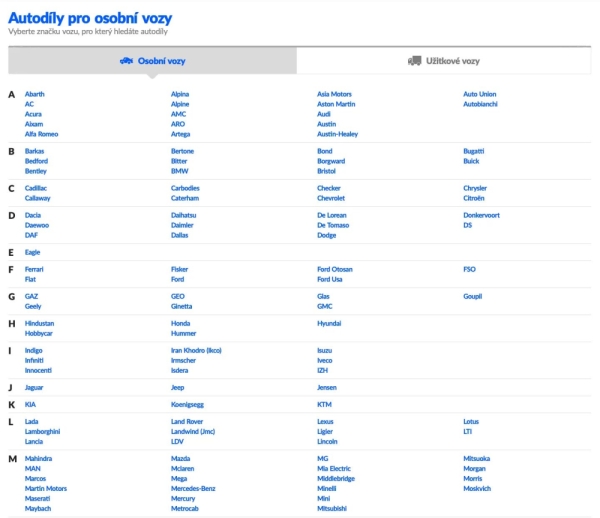
2. Auto parts manufacturer list page
The manufacturer list page should only reflect the brands that are actually available and relevant to your market and product range.
In particular, you should:
- Highlight the most popular brands.
- Hide irrelevant brands to speed up selection and navigation.
- Tailor the manufacturer selection as closely as possible to your brand (trucks, motorcycles, group specialists, etc.)
3. Vehicle model list – filter the relevant offer
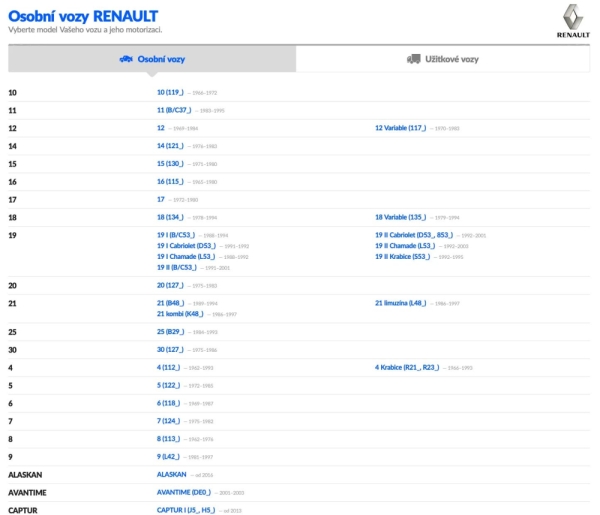
Vehicle models older than 1990 make up a very small part of orders today. Therefore, we recommend limiting the selection in the vehicle model list to models that are actually available on the market. TecDoc often contains vehicle models from the post-war period, which rather reduces the clarity of the vehicle selection.
There are vehicle manufacturer brands, such as Renault, where the oldest models are listed at the beginning of the model list and this really slows down the flow.
Again, the selection of models should correspond to your brand strategy.
4. Shipping and product price – the basic pillars of conversion
Product price
The market is still a strong determining factor in price. The ideal strategy combines competitive prices with clearly communicated additional benefits such as fast delivery, local warehouse, specialized consulting, availability guarantee or easy returns.
- Regularly monitor the prices of competitors – at least on a few selected products across the price spectrum.
- Don’t try to be the cheapest at all costs, but try to clearly communicate the additional value that the customer gains.
Pricing should primarily scale according to price levels. We address the issue of pricing separately within the kvik.shop academy.
Shipping and payment
In general, shipping options play a significant role in customer preferences. Although an appropriate shipping and payment solution is not difficult, it is often neglected.
- Offer all common methods. As a rule, this involves delivery by courier to the address, collection points and the involvement of classic postal services, which are popular in more remote regions.
- Allow customers to choose to pay via modern payment gateways. Fees are usually around 1%. Payment gateways are standard, significantly increase comfort and speed up your cashflow.
- The payment gateway should also support the popular ApplePay and GooglePay.
- Free delivery should have a clear goal and you should be able to verify this with measured results.
The customer is very sensitive to payment methods and shipping costs. Even a minimal difference compared to the regular shipping price can mean that the customer will order elsewhere.
5. Final recommendations
Optimizing an e-shop is not a one-time thing, but a continuous process. It is key to constantly monitor analytical data, analyze user behavior and respond quickly to changes in preferences. It is therefore absolutely necessary to measure customer behavior on the e-shop. What you cannot measure, you cannot manage.
Ing. Jiří Hofrichter
Co-founder & CEO of kvik.shop